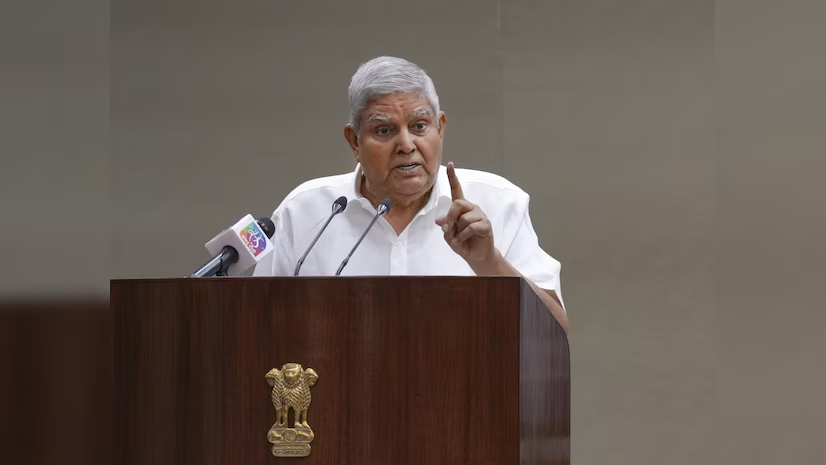
Dhankhar’s Critique of Supreme Court’s Article 142 Use
The invocation of Article 142 by the Supreme Court has recently become a focal point of debate, particularly after Vice President Jagdeep Dhankhar’s sharp criticism. Dhankhar characterized the use of this constitutional provision as akin to wielding a “nuclear missile” against democratic institutions, raising fundamental questions about the balance of power between the judiciary and the legislature.
What is Article 142?
Before diving into the controversy, let’s understand what Article 142 of the Indian Constitution actually entails. In essence, it grants the Supreme Court extraordinary powers to pass orders necessary for “doing complete justice” in any cause or matter pending before it. This decree is enforceable throughout India. The intention behind this provision, when it was drafted, was to equip the apex court with the necessary tools to address situations where existing laws or procedures might fall short of delivering equitable outcomes. Think of it as the Supreme Court’s way of saying, “We need to ensure justice prevails, even if it means going beyond the usual legal boundaries.”
Dhankhar’s Objections: A “Super Parliament”?
Vice President Dhankhar’s primary concern stems from the perception that the judiciary, through the expansive application of Article 142, is encroaching upon the legislative domain. He argues that the Supreme Court is essentially acting as a “super Parliament,” creating laws and policies that should rightfully be the prerogative of the elected representatives of the people. His argument boils down to the separation of powers doctrine, a cornerstone of our democratic framework. He believes the judiciary should interpret laws, not make them.
His specific points of contention usually revolve around instances where the Supreme Court, in its pursuit of justice, has issued directives that have significant policy implications. For instance, directions related to environmental regulations, electoral reforms, or even socio-economic policies, have drawn criticism. These directives, while often well-intentioned, are seen by some as overstepping the judicial mandate and venturing into areas where the Parliament should hold sway.
The Judiciary’s Perspective: “Complete Justice” Above All
The Supreme Court, on the other hand, defends its use of Article 142 by emphasizing its commitment to “complete justice.” The judges maintain that they invoke this provision only in exceptional circumstances, where the existing legal framework is inadequate or unable to address the complexities of a given situation. They argue that Article 142 is a necessary safeguard to ensure that justice is not merely a theoretical concept but a tangible reality for the citizens of India.
Furthermore, the judiciary contends that it is not enacting new laws but rather filling gaps in the existing legal framework. They often justify their actions by pointing to the Directive Principles of State Policy, which outline the socio-economic goals that the state should strive to achieve. The Supreme Court views itself as an interpreter and guardian of these principles, and Article 142 as a tool to give them teeth.
The Core Issue: Balancing Act
The crux of the matter lies in the delicate balancing act between judicial activism and judicial overreach. While the Supreme Court’s role as a protector of fundamental rights and a champion of justice is undeniable, there is also a legitimate concern about maintaining the integrity of the separation of powers. The debate surrounding Article 142 is not about whether the judiciary should be powerful, but rather about the appropriate limits of that power within a democratic framework. This conversation is really important to continue in order to build a stronger and better India.