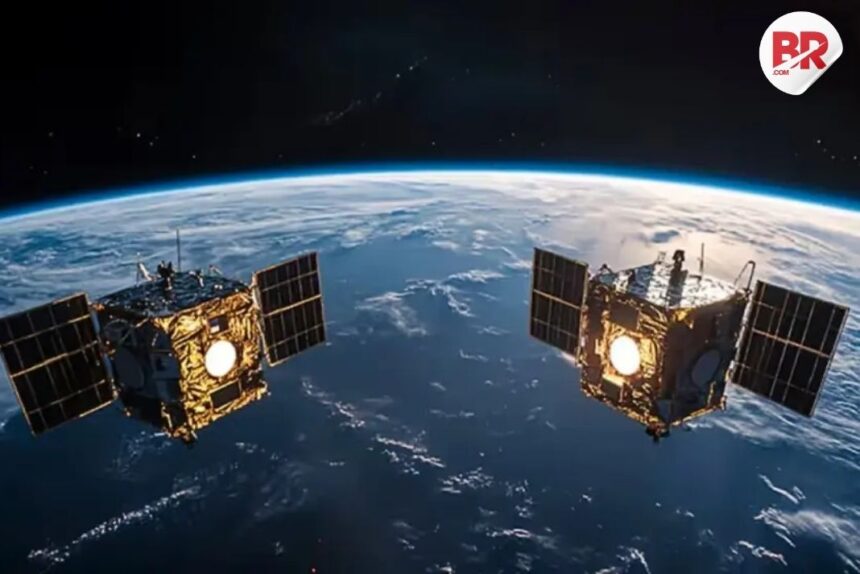
After successfully docking two satellites in space earlier this year, the Indian Space Research Organisation (ISRO) is now preparing for a second, more challenging mission. This new mission, called SpaDeX-2, will attempt to dock two satellites in an elliptical orbit instead of a circular one.
What Is Satellite Docking and Why It Matters
Docking is the process of joining two satellites or spacecraft in space so they can work together. This ability is very important for India’s future space plans, including the Chandrayaan-4 lunar mission and the proposed Indian Space Station (Bharatiya Antariksh Station).
What Happened in the First SpaDeX Mission?
In the first SpaDeX mission:
- ISRO launched two small satellites, each weighing 220 kg, into a 470-km circular orbit (a round path around Earth).
- The satellites were moved apart and then carefully brought back together.
- On January 16, the satellites successfully docked.
- The experiment also showed that the satellites could share power and receive commands as one combined system.
This achievement made India the fourth country in the world—after the US, Russia, and China—to demonstrate successful satellite docking in space.
What Makes the Second Mission Harder?
Docking in a circular orbit is easier because the speed and path of the satellites stay the same. But in an elliptical orbit, their speed and position keep changing, making it much harder to plan and perform the docking.
ISRO’s second SpaDeX mission will try to handle this difficult task. This skill will be useful in missions like Chandrayaan-4, where different parts of the spacecraft may be launched separately and must join together in space — in both Earth and Moon orbits.
Why Use Elliptical Orbits?
When ISRO sends missions to the Moon, it starts by placing the spacecraft in an elliptical orbit around Earth. Then, it uses engine burns at the closest point of the orbit to slowly move the spacecraft farther from Earth and eventually towards the Moon. That’s why learning to dock in elliptical orbits is important for future Moon missions.
What Did ISRO Learn from the First Docking?
In the first mission:
- ISRO was very careful because it was their first time doing docking.
- Special sensors were developed and tested for space conditions.
- Simulations were done on Earth before the actual docking.
- The satellites were brought closer slowly, stopping at points like 5 km, 1.5 km, 500 m, and so on.
In the second attempt (done after separating the satellites again), the docking process was smoother and faster because of the experience from the first trial. There were fewer stops, and the satellites docked more efficiently.