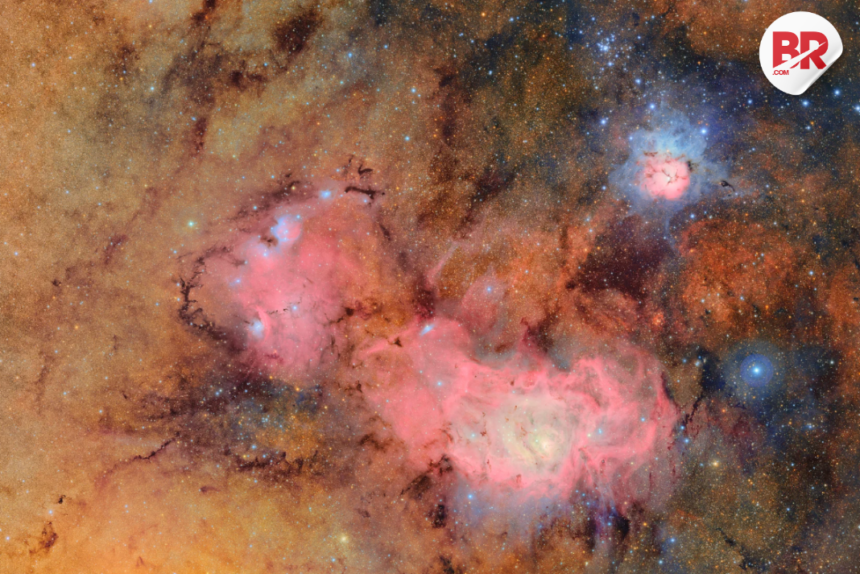
On June 23, 2025, the NSF–DOE Vera C. Rubin Observatory released its first-ever images, revealing an extraordinary look at our dynamic sky. This next-gen telescope, sitting atop Cerro Pachón in Chile, has already done in 10 hours what once took decades — capturing millions of stars and galaxies, and thousands of fast-moving asteroids.
That’s just the beginning.
Rubin Observatory isn’t just another telescope. It’s the most powerful optical sky survey machine ever built. Backed by the U.S. National Science Foundation (NSF) and the Department of Energy (DOE), this project is set to run a 10-year mission called the Legacy Survey of Space and Time (LSST). Every night, Rubin will scan the Southern Hemisphere sky — again and again — catching anything that moves, explodes, fades, or flickers.
The goal? To capture the ever-changing Universe in real time.
The Rubin Observatory’s 8.4-meter telescope uses the largest digital camera ever made — the size of a small car. Each shot covers an area of the sky as wide as 45 full Moons. These images aren’t just pretty pictures. They’re time-lapse records of the cosmos. They’ll help scientists track everything from asteroids to supernovae, and maybe even discover something we’ve never seen before.
Primeras imágenes del Observatorio Vera C. Rubin.
Créditos: NSF–DOE Vera C. Rubin Observatory pic.twitter.com/ib9zZqKv6P— Instituto de Astronomía UNAM (@iaunam) June 23, 2025
But Rubin isn’t only about distant galaxies. It’s also a big deal for Earth. By spotting asteroids and space rocks more efficiently than ever, it will boost planetary defense efforts — helping us find threats before they find us.
And the numbers? Massive. Rubin will collect 20 terabytes of data every night. In 10 years, it’ll build a 500-petabyte archive — enough to keep scientists busy for decades. All this data will be available for researchers and the public alike. Through tools like the SkyViewer app, you can now explore space in both sight and sound.
Over the course of a decade, the @NSF-DOE (@Energy) Vera C. Rubin Observatory will map the sky. At today’s First Look event, we’re releasing its first amazing images. They’ll be a preview of the observatory’s ability to reveal insights into our universe: https://t.co/lxPkRLIsdI pic.twitter.com/rSyrwtWTbA
— DOE Office of Science (@doescience) June 23, 2025
The observatory is named after Vera C. Rubin, the legendary astronomer who gave us the first solid proof of dark matter. Now, her namesake facility will dive deeper into the mysteries of dark energy, the expanding Universe, and the unseen forces that shape reality.
This launch is more than a tech milestone. It’s a proud moment for science and a reminder of what global teams, long-term vision, and bold ideas can do.
Also Read Falcon 9 Rocket Returns to Earth 8 Minutes After Sending Shubhanshu Shukla to Space