Astronomers have made a groundbreaking discovery using the James Webb Space Telescope (JWST). They found the most distant galaxy ever observed, but there’s something surprising about it: this galaxy, known as RUBIES-UDS-QG-z7, has already stopped forming new stars.
This galaxy is located more than 13 billion light-years away, making it the farthest and most massive “dead galaxy” ever discovered. The discovery was made by an international team of scientists, led by researchers from the University of Geneva in Switzerland.
For a long time, scientists believed that only galaxies that were actively forming stars could be seen in the early Universe. However, the James Webb Space Telescope is revealing that some galaxies stopped forming stars earlier than expected. This discovery challenges our understanding of how galaxies evolve.
What is a Dead Galaxy?
A “dead galaxy” is a galaxy that has stopped creating new stars. This happens when it runs out of gas, mostly hydrogen, which is needed to make new stars. Without enough cold and dense gas, star formation slows down and eventually stops. Other factors, such as supernovae (exploding stars) or black holes, can also push this gas out of the galaxy. As a result, the galaxy becomes filled with old stars, and no new stars are formed.
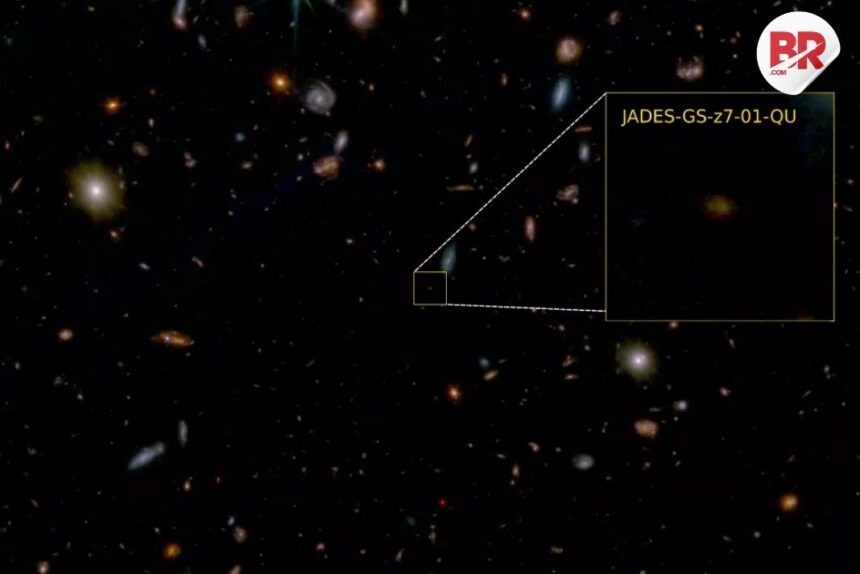
The oldest known “dead” galaxy, JADES-GS-z7-01-QU, was found last year by the James Webb Space Telescope. It stopped making stars when the Universe was just 700 million years old.
Read More: China Launches Shenzhou 20 Mission to Tiangong Space Station on April 24
How Do Galaxies Grow and Die?
Galaxies grow by taking in gas and turning it into new stars. The bigger a galaxy gets, the better it can gather gas, which speeds up star formation. But eventually, galaxies go through a process called “quenching,” where they stop forming new stars and stop growing.
What is Quenching?
Big galaxies, especially those shaped like ellipses, are more likely to experience quenching. These galaxies take a long time to form because they build up large populations of stars. One of the biggest mysteries in astrophysics is what causes galaxies to stop making stars.
“Finding massive galaxies that stopped making stars in the early Universe is important because it helps us understand how these galaxies formed,” said the researchers from the University of Geneva. They found one such galaxy that made stars with a mass equal to 15 billion times the mass of the Sun but then stopped producing stars.
What’s Next?
The RUBIES-UDS-QG-z7 galaxy is about 650 million light-years away and is very small, but it has a very dense concentration of stars. This could mean that this galaxy might eventually grow into one of the oldest and largest elliptical galaxies we see today.
Read More: NASA’s Big Decision! Will Boeing’s Starliner Finally Be Ready for Space? Next Mission Set for 2026
The Atacama Large Millimeter/submillimeter Array (ALMA), a powerful radio telescope in Chile, might help the JWST study this galaxy further.
“The discovery of RUBIES-UDS-QG-z7 gives strong evidence that some of the massive elliptical galaxies we see nearby today may have already started forming in the first few hundred million years after the Big Bang,” the researchers explained.